
Coast FIRE vs FIRE vs Barista FIRE
Coast FIRE vs traditional FIRE vs Barista FIRE (plus Lean and Fat): what each milestone means, who it fits, and how to pick a path with a free calculator.
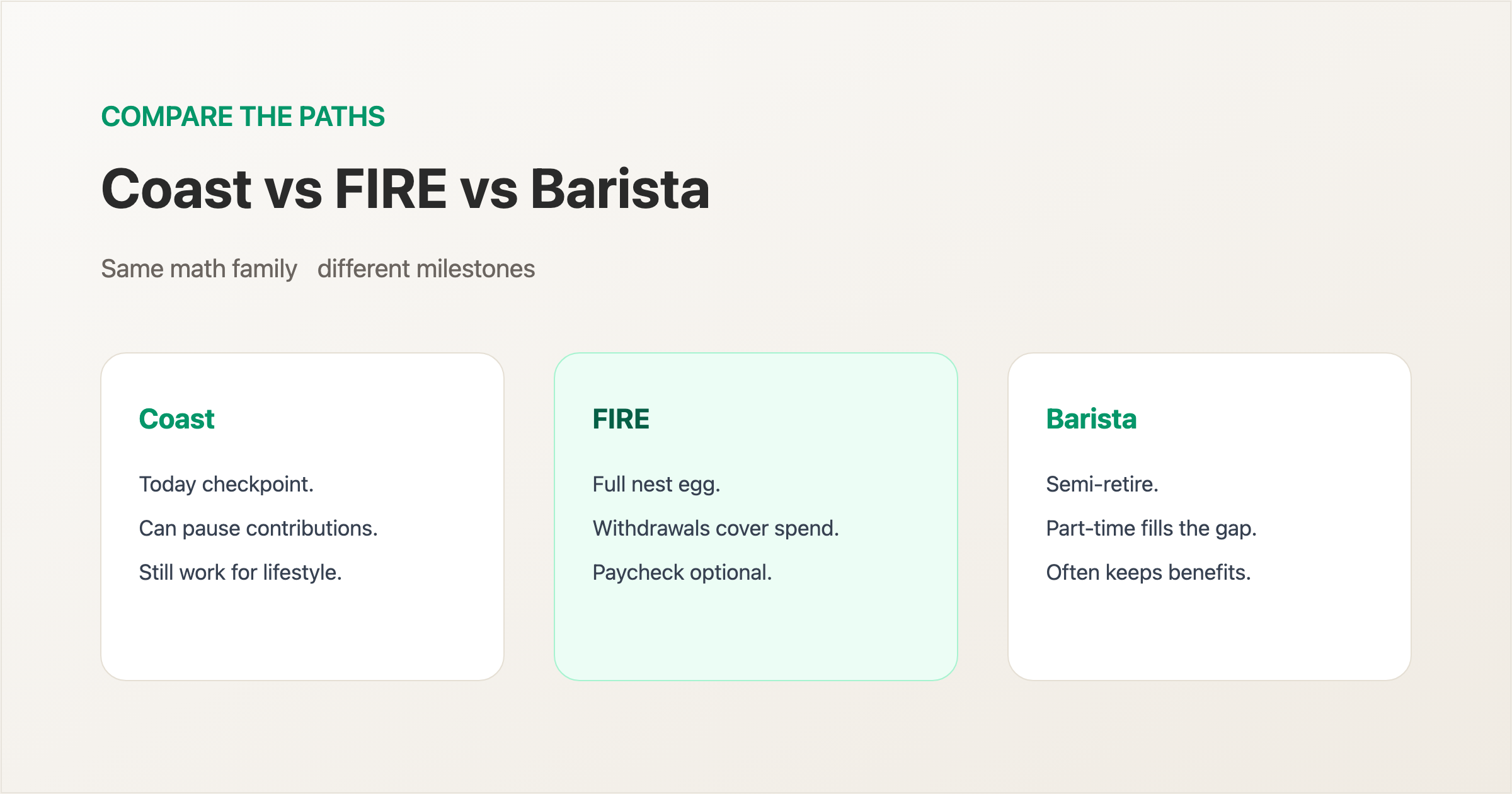
Coast FIRE, traditional FIRE, and Barista FIRE answer different questions. Same math family (spend, withdrawal rate, portfolio) — different milestones and lifestyle trade-offs.
Quick map:
| Path | Core idea | Work for living costs? |
|---|---|---|
| Traditional FIRE | Nest egg can fund spending via withdrawals | Usually no (full FI) |
| Coast FIRE | Today’s portfolio can compound to FIRE later without new contributions | Usually yes |
| Barista FIRE | Smaller nest egg + part-time / lower-stress work covers the gap | Yes, part-time |
Run your own Coast + FIRE targets on the free Coast FIRE calculator. For definitions of Coast, see What Is Coast FIRE?.
Key takeaway (cite this)
FIRE = can stop needing a paycheck (withdrawals cover spend).
Coast = can stop retirement contributions; compounding still reaches FIRE later.
Barista = semi-retire with part-time income (often + benefits) filling the gap.
Lean / Fat are about how much you spend (and thus how large the nest egg is) — not the same axis as Coast vs Barista.
Traditional FIRE
Goal: Hit your FIRE number (spend ÷ SWR), then leave full-time work if you choose.
- Highest early savings pressure if you want the earliest quit date
- Day-to-day funded by portfolio withdrawals
- Sequence-of-returns risk matters once you withdraw
Best when: you can sustain a high savings rate and want full optionality off the paycheck soon.
Coast FIRE
Goal: Hit a cheaper today Coast FIRE number so expected compounding finishes the job by your target age — even if contributions drop to zero.
- Still earn for rent, food, healthcare
- Often psychologically lighter than max-saving forever
- Milestone = optionality, not a rule that you must stop investing
Best when: you want career flexibility / lower pressure while keeping FI on track.
Barista FIRE
Goal: Semi-retirement. Portfolio covers part of spending; part-time or lower-stress work (the “barista” shorthand — not literal coffee) covers the rest — often with health insurance or purpose.
Rough framing:
Portfolio supports some spend via a conservative withdrawal plan; earned income covers the remainder until you reach classic FIRE or another bridge (e.g. benefits, partner income).
Best when: you want out of high-intensity work earlier than full FIRE, and you’re fine trading some portfolio size for continued (lighter) work.
You don’t need a separate branded “barista fire calculator” product — model spend − expected work cover, then size the nest egg for the residual with the same SWR math (or stress-test in WorthCay).
Side-by-side
| Coast | Traditional FIRE | Barista | |
|---|---|---|---|
| Portfolio target | Coast number (today) | Full FIRE number | Often between Coast and FIRE (case-by-case) |
| Contributions | Can pause | Can pause (you’re done saving for FI) | May continue lightly |
| Paycheck | Full-time common | Optional | Part-time / flexible common |
| Benefits | Via employer job | Via FI plan / marketplace | Often a key reason to keep work |
| Main risk | Assumptions + still needing income | Sequence risk in retirement | Job + health coverage changes |
Where Lean FIRE and Fat FIRE fit
Lean FIRE and Fat FIRE describe lifestyle spend (and therefore nest-egg size), not the Coast/Barista timeline:
| Label | Typical idea | Nest egg (at 4% SWR) |
|---|---|---|
| Lean FIRE | Frugal spend (e.g. ~$25–40k) | Smaller (e.g. ~$0.6–1.0M) |
| “Regular” FIRE | Mid lifestyle (e.g. ~$50–70k) | Mid (e.g. ~$1.25–1.75M) |
| Fat FIRE | Higher spend (e.g. $100k+) | Larger (e.g. $2.5M+) |
You can be Lean + Coast, Fat + traditional FIRE, or mid spend + Barista. Spending level × work model are independent dials.
For fat / lean calculator-style searches: start with spend ÷ SWR on the Coast FIRE calculator, then pick Coast vs full FIRE vs a Barista gap.
Simple decision guide
- Need withdrawals to live this year? → You’re in (or near) traditional FIRE territory — size the nest egg carefully.
- Years left, want optionality, still happy working for lifestyle? → Aim for Coast first.
- Want out of the grind but OK with part-time + benefits? → Model Barista (spend − work cover).
- Unsure on spend level? → Sketch Lean / mid / Fat ranges, then pick a path.
Many people stack milestones: hit Coast → keep contributing → optional Barista bridge → full FIRE.
Worked sketch (illustrative)
Same person, $50k/year target spend, 4% SWR → FIRE ≈ $1.25M.
| Path | Rough meaning |
|---|---|
| Traditional FIRE | Need ~$1.25M invested before quitting |
| Coast (20 years, ~4% real) | Need ~$570k today; still work for living costs |
| Barista | e.g. earn $25k part-time → portfolio only needs to support ~$25k → nest egg ~$625k (plus job risk) |
Your numbers will differ — treat this as structure, then run inputs.
FAQ
What is the difference between Coast FIRE and FIRE?
FIRE: nest egg funds spending via withdrawals. Coast: today’s portfolio can compound to that nest egg later without new contributions; you usually still work for living costs.
What is Barista FIRE?
Semi-retirement: smaller (or mid) portfolio plus part-time / lower-stress work (often with benefits) covers the gap.
Is Lean or Fat FIRE the same as Coast?
No. Lean/Fat = spending level. Coast = timing checkpoint before full FIRE.
Which path should I choose?
Coast for optionality while earning; classic FIRE to leave the paycheck; Barista for part-time bridge. Numbers first — calculator.
Do I need a barista fire calculator?
Model residual spend after work income, then apply SWR. WorthCay’s calculator covers Coast + FIRE targets; adjust spend for the Barista gap.
Next step
- Compare Coast vs FIRE on the free Coast FIRE calculator.
- Learn the Coast formula in depth: Coast FIRE Number Explained.
- Size the classic nest egg: How to Calculate Your FIRE Number.
- Keep invested balances current with net worth tracking.
Pick the milestone that matches the life you want this decade — then let the math show the distance.