
Coast FIRE Number Explained (With Formula)
How to calculate your Coast FIRE number: FIRE ÷ (1 + real return)^years — with worked examples, age tables, and a free calculator.
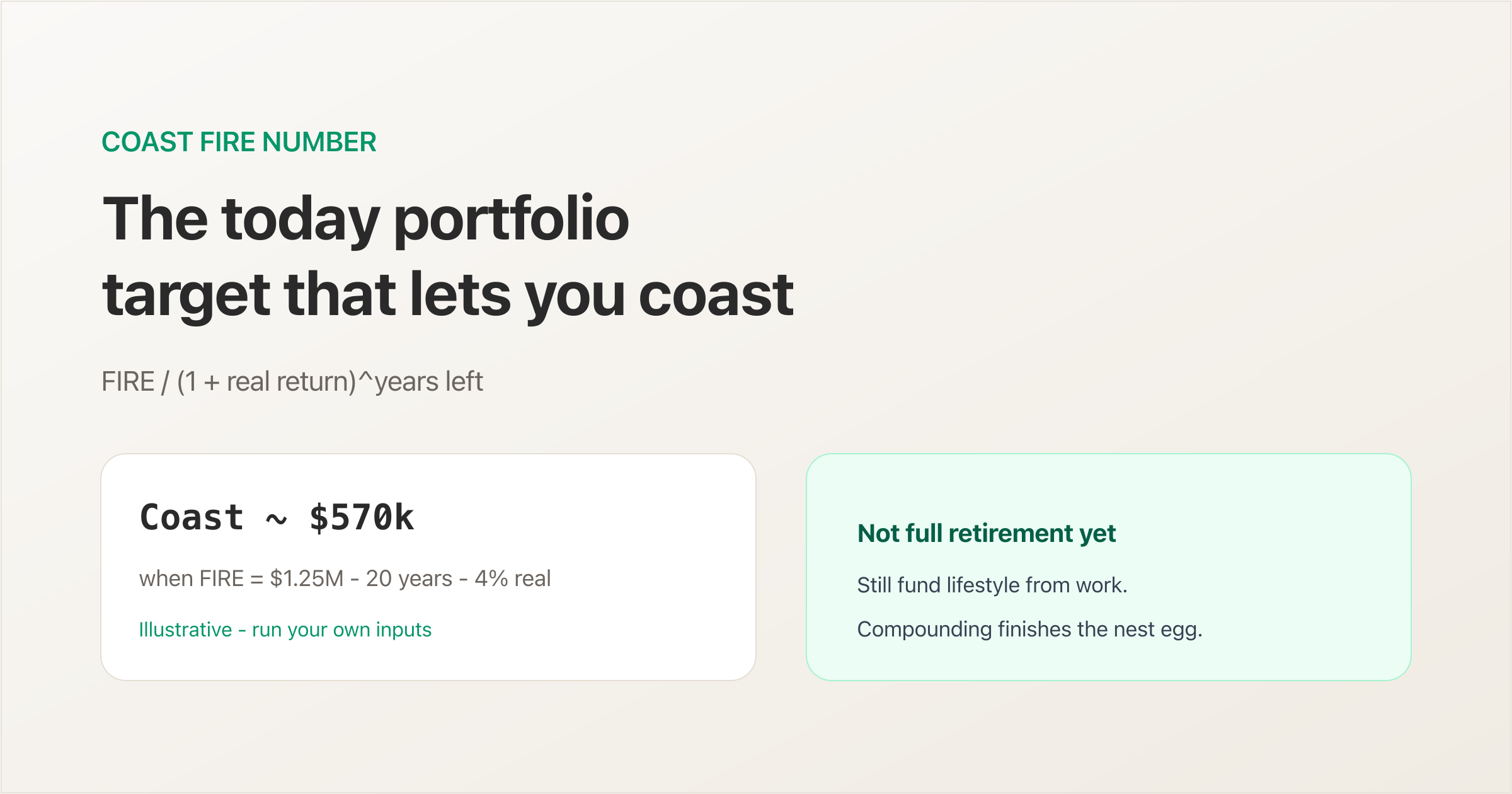
Your Coast FIRE number is the invested portfolio you need today so that compounding alone can still reach your full FIRE nest egg by retirement age — even if you never add another retirement contribution.
It’s not “how much you need to retire tomorrow.” It’s the cheaper checkpoint that unlocks the option to coast. For the broader idea, see What Is Coast FIRE?. To run your own inputs now, open the free Coast FIRE calculator.
Coast FIRE number in one sentence
Coast FIRE number = how large your invested nest egg must be right now so expected real growth can finish the job by your target retirement age.
You usually keep working for rent, food, and healthcare. You’ve just removed the requirement to keep maxing retirement savings forever.
The formula
Step 1 — Pick annual spending
Use a realistic retirement spending target in today’s dollars (what you’d need per year if you retired with today’s prices).
Step 2 — Pick a safe withdrawal rate (SWR)
Many plans start near 4%. Lower SWR → larger nest egg (more conservative). Higher SWR → smaller nest egg (more aggressive).
Step 3 — Get your FIRE number
FIRE number = annual spend ÷ SWR
Example: $50,000 ÷ 0.04 = $1,250,000.
Step 4 — Pick years left and a real return
- Years left (n) = target retirement age − current age
- Real return (r) = expected return after inflation (WorthCay uses Fisher:
(1 + nominal) / (1 + inflation) − 1)
Step 5 — Discount FIRE back to today
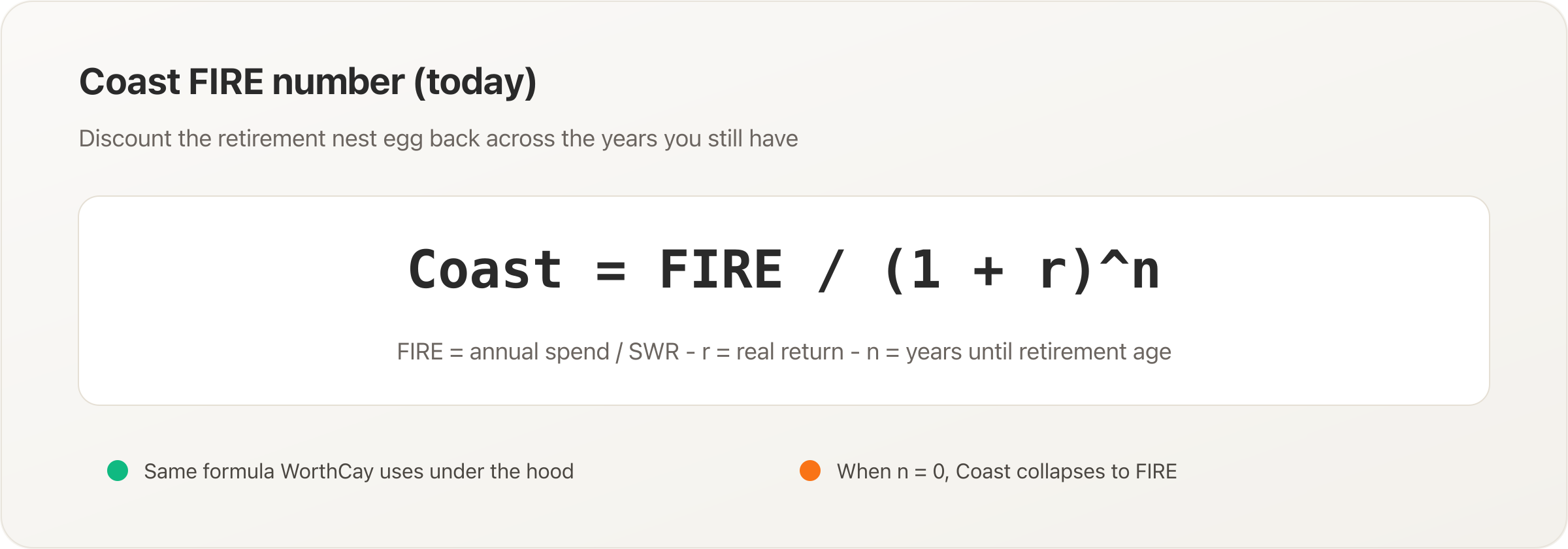
Coast number = FIRE ÷ (1 + r)^n
That single number is your Coast FIRE number — the today portfolio target.
Quick path: skip the spreadsheet and calculate coast fire number on WorthCay with age, spend, portfolio, return, and SWR.
Worked example
Assumptions (illustrative only):
| Input | Value |
|---|---|
| Annual spend | $50,000 |
| SWR | 4% |
| FIRE number | $1,250,000 |
| Years left | 20 |
| Real return | ~4% |
Coast = $1,250,000 ÷ (1.04)^20 ≈ $570,000
Meaning: if you already have about $570k invested (brokerage + retirement accounts that belong in the FI plan), you can in theory stop new contributions and still expect ~$1.25M by retirement — as long as returns and spending hold. Lifestyle still needs a paycheck until you actually FIRE.
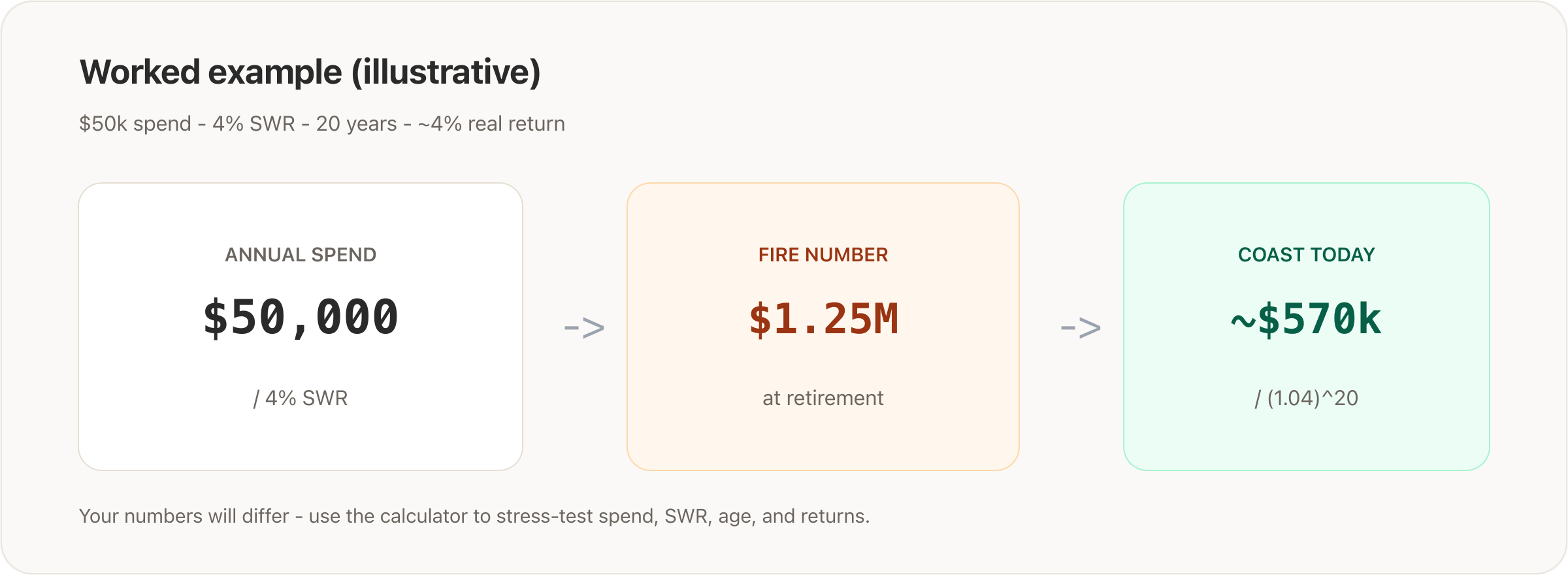
Change any lever and the Coast line moves. That’s why a calculator beats a static blog example.
Coast FIRE number by age (same FIRE target)
Same FIRE nest egg ($1.25M) and ~4% real return; only years left change. Younger → more compounding runway → lower Coast number today.
| Age now | Retire at 65 | Years left | Approx. Coast number |
|---|---|---|---|
| 30 | 65 | 35 | ~$317,000 |
| 35 | 65 | 30 | ~$385,000 |
| 40 | 65 | 25 | ~$469,000 |
| 45 | 65 | 20 | ~$570,000 |
| 50 | 65 | 15 | ~$694,000 |
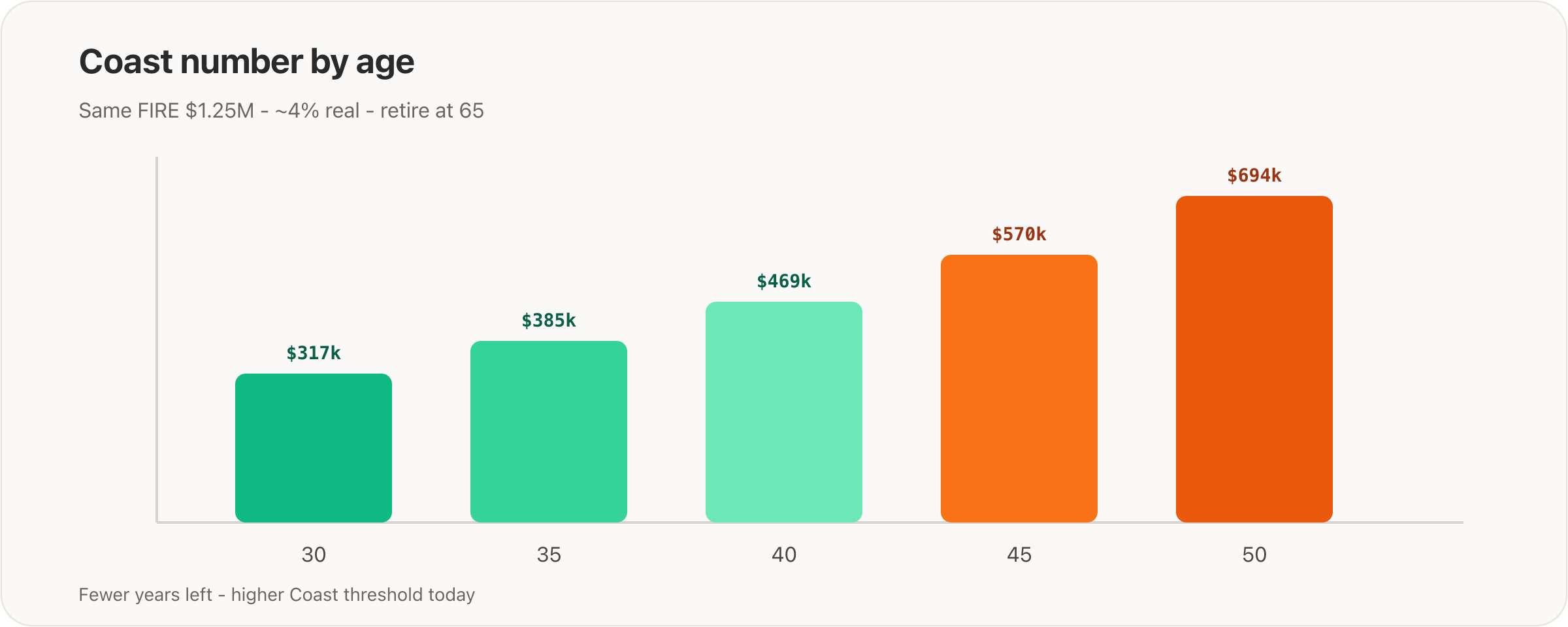
Your row will differ if spend, SWR, or returns differ — treat this as order-of-magnitude, then stress-test in the calculator.
What belongs in the Coast portfolio?
Count invested assets that are meant to fund retirement:
- 401(k), IRA, Roth, taxable brokerage
- Other long-horizon investable accounts you actually plan to draw from
Usually exclude (or treat carefully):
- Primary-home equity as if it were liquid FIRE fuel
- Short-term emergency cash you need for life, not compounding
- Speculative assets you wouldn’t rely on for a spending plan
Keep the invested total honest with net worth tracking habits — Coast math is only as good as the balances behind it.
Sensitivity: what moves the number most?
| If you… | Coast number tends to… |
|---|---|
| Raise annual spend | Rise (FIRE grows first) |
| Lower SWR (e.g. 3.5%) | Rise |
| Expect higher real returns | Fall |
| Have fewer years left | Rise (less runway) |
| Are closer to the FIRE age | Approach the full FIRE number |
Small assumption changes compound. Revisit the number when salary, family size, or markets shift — then update Actual vs Goal in Progress.
How to calculate your Coast FIRE number (checklist)
- Estimate annual retirement spend (today’s dollars).
- Choose an SWR → compute FIRE.
- Set current age, retirement age, and a real return.
- Compute Coast = FIRE / (1 + r)^n.
- Compare to current invested → gap or “already coasting.”
- Optional: keep contributing anyway for margin, or switch to a Barista-style path later.
Or do steps 1–5 in one place: WorthCay Coast FIRE calculator.
FAQ
What is a Coast FIRE number?
It’s the today invested-portfolio target that lets expected compounding reach your FIRE number by retirement age without further contributions.
How do I calculate my Coast FIRE number?
Compute FIRE = spend ÷ SWR, then Coast = FIRE ÷ (1 + real return)^years left. Fastest: use WorthCay’s Coast FIRE calculator.
Is “coastfire number” the same thing?
Yes — coast fire number, coastfire number, and Coast FI number refer to the same checkpoint.
What if I’ve already passed my Coast number?
You’ve reached the milestone. You can reduce contributions, keep investing to hit full FIRE sooner, or add a safety margin — optionality, not a rule to stop saving.
Does the formula use nominal or real returns?
Use a real (inflation-adjusted) return when FIRE and spend are in today’s dollars. WorthCay derives real return from your nominal return and inflation inputs.
How is this different from my FIRE number?
FIRE number is the nest egg at retirement. Coast number is that nest egg discounted back to today for the years you still have to compound.
Next step
- Run your Coast + FIRE numbers on the free Coast FIRE calculator.
- Read What Is Coast FIRE? if you want meaning and trade-offs before the math.
- Keep invested balances current with net worth tracking, then watch Actual vs Goal on the demo Progress dashboard.
Your Coast FIRE number isn’t a personality test — it’s a today target. Get it, then decide how hard you still want to push.