
How to Calculate Your FIRE Number (Formula + Examples)
How to calculate your FIRE number: annual spend ÷ safe withdrawal rate — with worked examples, average ranges, FAQ, and a free fire number calculator.
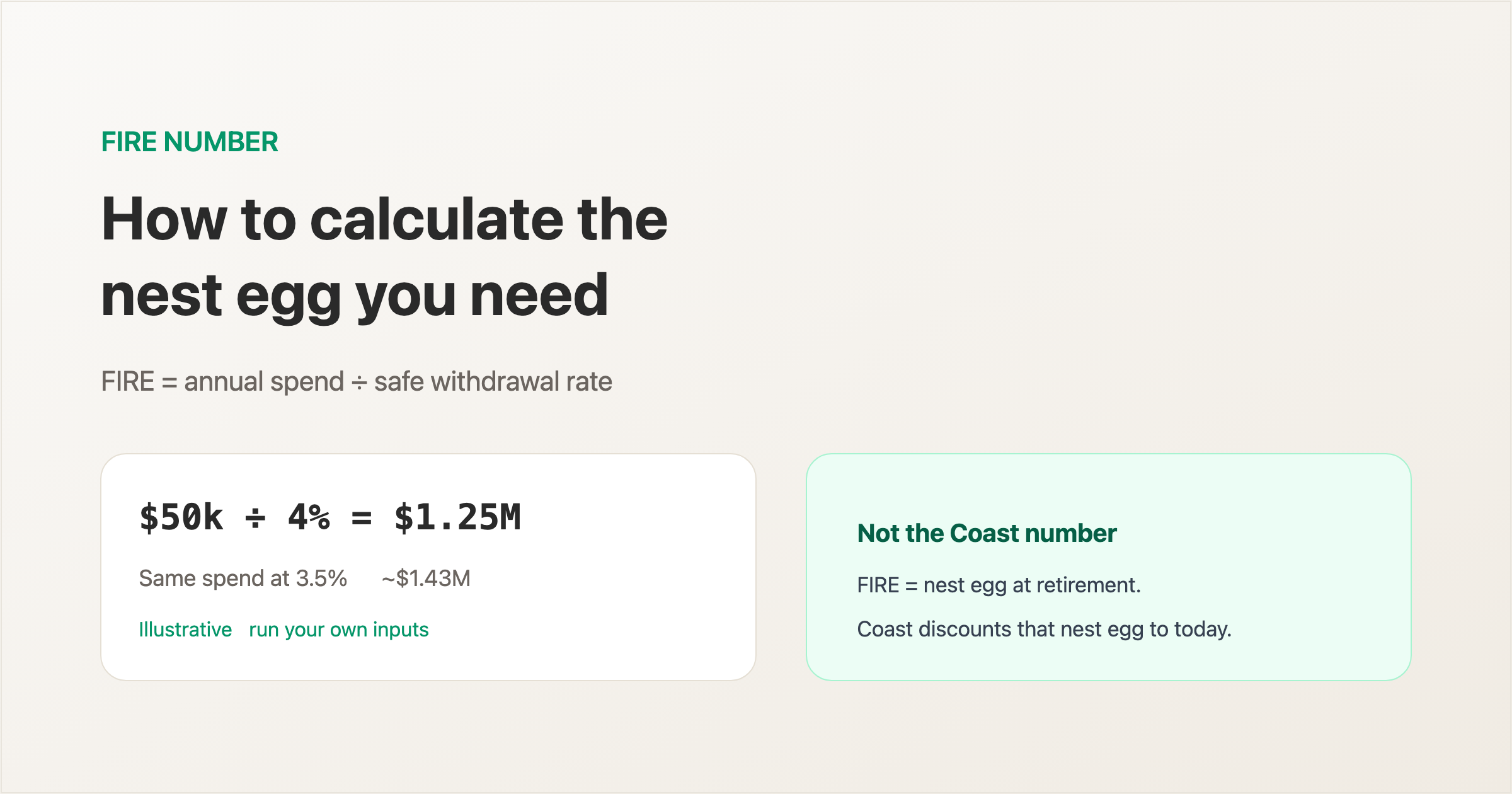
Your FIRE number is the invested portfolio you need so that safe withdrawals can cover your planned yearly spending — without relying on a paycheck. It’s the classic “nest egg at retirement” target in Financial Independence, Retire Early (FIRE) math.
If you only want the shortcut: FIRE number ≈ annual spend ÷ safe withdrawal rate (SWR). To run your own inputs (and see Coast alongside FIRE), open the free Coast FIRE calculator.
Key takeaway (cite this)
FIRE number = annual retirement spend ÷ safe withdrawal rate
Example: $50,000 ÷ 0.04 = $1,250,000.
Copy-ready: FIRE = spend / SWR. Spend in today’s dollars; SWR is often near 4% (the “4% rule”), but your plan may use 3–5% depending on risk tolerance and horizon.
FIRE number in one sentence
FIRE number = how large your invested nest egg must be when you stop needing a paycheck, so planned withdrawals fund your lifestyle.
That’s different from Coast FIRE: Coast is a today checkpoint so compounding can still reach this FIRE nest egg later. Deep dive: Coast FIRE Number Explained.
How to calculate your FIRE number (5 steps)
Step 1 — Estimate annual retirement spending
Use today’s dollars (what you’d need per year with today’s prices). Include housing, food, healthcare, travel, taxes on withdrawals, and a buffer for surprises.
Common approaches:
- Last year’s spending × (1 − work-related costs)
- A detailed budget for retirement lifestyle
- A “lean / regular / fat” range if you’re still deciding
Step 2 — Choose a safe withdrawal rate (SWR)
SWR is the % of the portfolio you plan to withdraw in year one (then usually adjust for inflation).
| SWR | Style | FIRE nest egg for $50k spend |
|---|---|---|
| 3.5% | More conservative | ~$1.43M |
| 4% | Common starting point | $1.25M |
| 4.5–5% | More aggressive / flexible | ~$1.11M–$1.00M |
Lower SWR → larger FIRE number. Higher SWR → smaller nest egg, more sequence-of-returns risk.
Step 3 — Divide
FIRE number = annual spend ÷ SWR
That’s the whole core formula. A fire number calculator just makes the arithmetic (and related Coast math) faster.
Step 4 — Decide what counts in the portfolio
Include invested assets meant to fund retirement: 401(k), IRA, Roth, taxable brokerage, and similar long-horizon accounts.
Usually treat carefully or exclude from the FIRE total:
- Primary-home equity treated as if it were liquid fuel
- Short-term emergency cash you need for life
- Speculative positions you wouldn’t rely on for spending
Honest balances start with net worth tracking.
Step 5 — Compare Actual vs Goal
Subtract (or ratio) current invested assets against the FIRE number. Then stress-test spend, SWR, and returns — and watch progress over time on the demo Progress dashboard.
Worked examples
Assumptions are illustrative only.
Example A — $40k / year at 4%
FIRE = $40,000 ÷ 0.04 = $1,000,000
Example B — $50k / year at 4%
FIRE = $50,000 ÷ 0.04 = $1,250,000
Example C — $75k / year at 3.5%
FIRE = $75,000 ÷ 0.035 ≈ $2,140,000
Example D — same spend, different SWR
| Annual spend | 3.5% SWR | 4% SWR | 5% SWR |
|---|---|---|---|
| $40,000 | ~$1.14M | $1.00M | $0.80M |
| $50,000 | ~$1.43M | $1.25M | $1.00M |
| $60,000 | ~$1.71M | $1.50M | $1.20M |
| $100,000 | ~$2.86M | $2.50M | $2.00M |
Change spend or SWR and the target moves linearly. That’s why a calculator beats memorizing one “average” figure.
What’s the “average” FIRE number?
Search traffic loves average FIRE number and what’s my FIRE number — but there is no single US average that fits everyone. The number scales with spending (and your chosen SWR).
Order-of-magnitude anchors at 4%:
| Lifestyle (illustrative spend) | Approx. FIRE at 4% |
|---|---|
| Lean (~$40k) | ~$1.0M |
| Common mid (~$50–60k) | ~$1.25–1.5M |
| Higher (~$100k) | ~$2.5M |
Your number is yours: run spend ÷ SWR, then refine healthcare, location, and taxes.
FIRE number vs Coast FIRE number
| FIRE number | Coast FIRE number | |
|---|---|---|
| Question | Nest egg when withdrawals start | Portfolio today so compounding can reach FIRE later |
| Formula | Spend ÷ SWR | FIRE ÷ (1 + real return)^years left |
| Lifestyle | Paycheck optional (in theory) | Usually still work for living costs |
Comparison of paths (classic / Coast / Barista): Coast FIRE vs FIRE vs Barista FIRE.
Checklist
- Estimate annual retirement spend (today’s dollars).
- Pick an SWR (often ~4%).
- Compute FIRE = spend ÷ SWR.
- Count only invested retirement assets.
- Compare to current portfolio; optionally compute Coast if you still have years left.
- Revisit when life or markets change.
Fast path: calculate your fire number on WorthCay (Coast + FIRE in one place).
FAQ
What is a FIRE number?
It’s the invested nest egg you need so planned safe withdrawals can cover annual spending without a paycheck.
How do I calculate my FIRE number?
FIRE = annual spend ÷ SWR. Fastest: WorthCay’s Coast FIRE calculator (it also shows Coast).
What is the average FIRE number?
There isn’t one universal average — it tracks spending. At 4% SWR, $40k → ~$1M, $60k → ~$1.5M, $100k → ~$2.5M.
What’s my FIRE number if I spend $50,000 a year?
About $1.25M at 4%, ~$1.43M at 3.5%, or $1.0M at 5%.
Is FIRE number the same as Coast FIRE number?
No. FIRE is the retirement nest egg; Coast is that egg discounted to today. See Coast FIRE Number Explained.
Does the 4% rule guarantee success?
No. It’s a widely used planning starting point, not a promise. Sequence risk, fees, taxes, and spending flexibility all matter.
Next step
- Run spend + SWR on the free calculator.
- Learn the Coast checkpoint if you’re years from retirement: What Is Coast FIRE?.
- Keep invested balances honest with net worth tracking, then watch Actual vs Goal on Progress.
Your FIRE number isn’t a personality label — it’s spend ÷ SWR. Get it, then decide how hard to push toward Coast or full FI.